When a young person chooses a major, the decision often carries a family's hopes for stability. A familiar company name or a popular career can make the future feel easier to imagine. Microsoft's latest workforce announcement invites us to look more carefully at what we are preparing students to do.
On October 26, Microsoft introduced a voluntary exit offer. Reuters reported that about 60,000 employees would be eligible. That figure describes the people offered a choice, not confirmed departures or 60,000 layoffs. Microsoft's own announcement describes a time-limited program for eligible employees in participating teams, with financial support and career planning resources. [1][2]
This is separate from Microsoft's July 6 announcement eliminating around 4,800 roles. In that earlier communication, the company explicitly said those roles were not being replaced by AI, while acknowledging that AI was changing everyday work. Keeping these events distinct matters, especially when a headline may influence a student's confidence about their future. [3]
What the employment evidence can tell us
Stanford HAI's October 21 report adds another perspective. Its Digital Economy Lab is tracking employment and AI adoption through dashboards, including one built with anonymized ADP payroll data. The report describes declining employment among 22- to 25-year-olds in software development and customer service, alongside weaker employment growth in occupations where AI use leans toward automation. [4]
These findings concern particular groups and patterns. They do not establish that AI caused every job loss, that all young workers face the same prospects, or that studying technology has become pointless. I see them as a reason to examine how students enter a profession and gain experience, rather than as a verdict on their ambitions.
Where AI related creative demand is growing
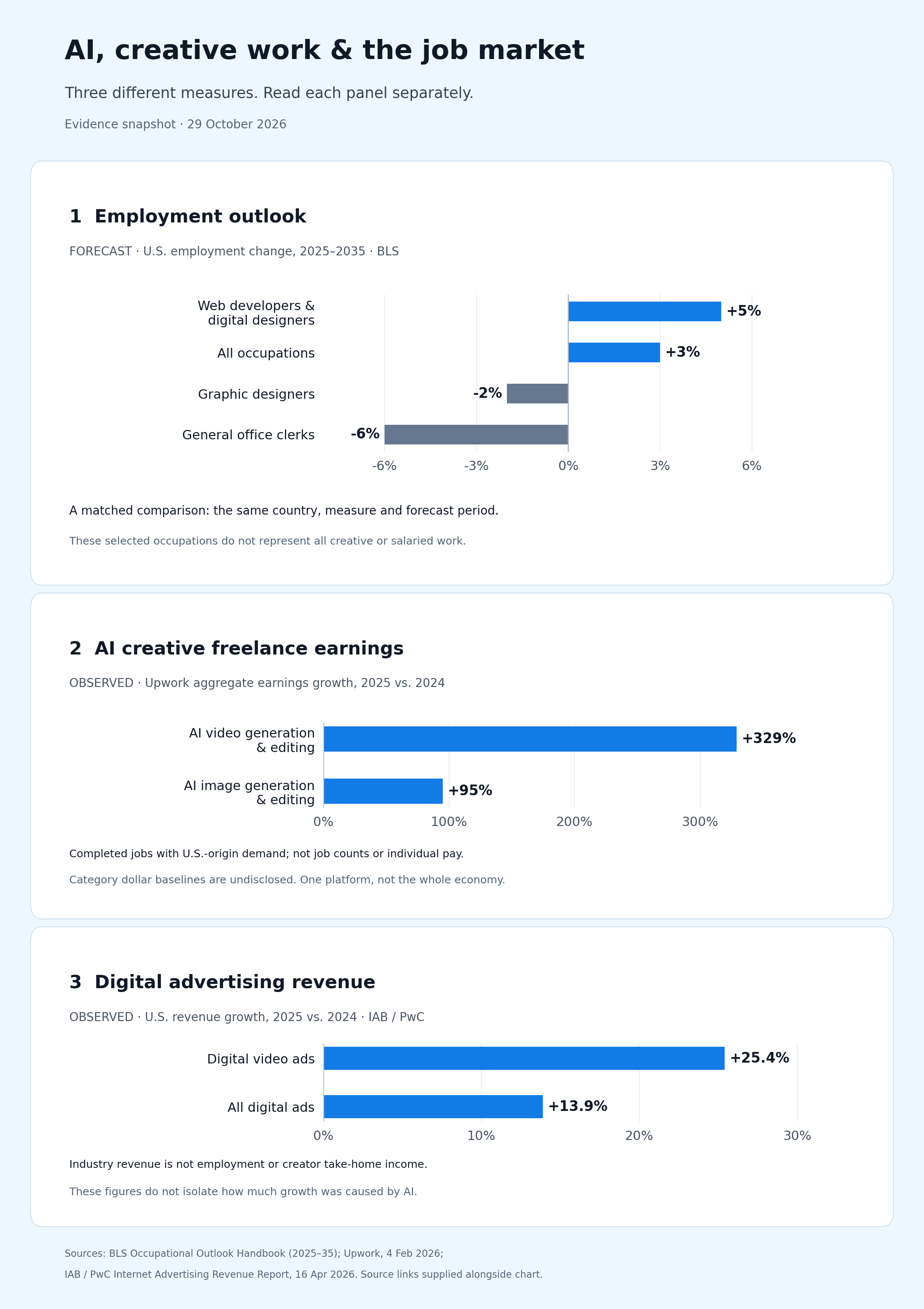
Upwork's February 2026 report offers a specific market signal. Aggregate freelancer earnings from completed jobs in AI video generation and editing rose 329% in 2025 compared with 2024; AI image generation and editing rose 95%. The analysis covers U.S.-origin demand on Upwork, rather than the whole economy. [5]
These percentages measure total earnings across each skill category, not individual salary increases or growth in worker numbers. Upwork does not disclose the absolute earnings behind these two rates. A rapidly growing category may still be small, and its growth does not tell us how earnings are distributed among freelancers.
There is also evidence of expansion in the broader digital media market. IAB's 2025 Internet Advertising Revenue Report, conducted by PwC and released in April 2026, puts U.S. digital video advertising revenue at $78 billion, up 25.4% from 2024. Total digital advertising grew 13.9%. Those are advertising revenues, not jobs, and the figures do not establish that AI caused the increase. [6]
Comparing employment on the same basis
For an employment comparison, the U.S. Bureau of Labor Statistics projects these changes from 2025 to 2035: web developers and digital designers, +5%; all occupations, +3%; graphic designers, −2%; and general office clerks, −6%. These are forecasts for employment levels, not observed changes or annual growth rates. [7][8][9]
The contrast is more useful than a blanket claim that creative careers are growing while conventional jobs disappear. Some creative occupations face projected contraction too. A nine-to-five schedule is not an occupational category; people doing creative and technical work may also hold salaried, full-time jobs. The accompanying charts therefore keep employment projections, freelance earnings, and advertising revenue separate.
Read chart data and limitations
Evidence snapshot: 29 October 2026. Each table measures something different.
| Occupation | Change |
|---|---|
| Web developers and digital designers | +5% |
| All occupations | +3% |
| Graphic designers | −2% |
| General office clerks | −6% |
The same country, measure and forecast period. Selected occupations do not represent all creative or salaried work. These are projections, not observed or annual growth.
| Skill category | Growth |
|---|---|
| AI video generation and editing | +329% |
| AI image generation and editing | +95% |
Completed jobs with U.S.-origin demand. These are not job counts or individual pay increases. Category dollar baselines are undisclosed. One platform, not the whole economy.
| Advertising category | Growth |
|---|---|
| Digital video ads | +25.4% |
| All digital ads | +13.9% |
Industry revenue is not employment or creator take-home income. These figures do not isolate how much growth was caused by AI. Original sources are linked at the end of this article.
Look at the work before choosing the major
I ask students to look at actual job requirements before deciding how to prepare for a career. If a student wants to become a data scientist, I want them to explore the work companies are asking people to perform. The name of the degree alone cannot answer that question.
A useful exercise is to compare several current job descriptions. Notice the problems the employer needs solved, the tools mentioned, and the expectations for communication. Then compare those requirements with a program's courses and opportunities for practical work. A student can begin to identify what they already understand and what they still need to learn.
Today's listings are clues, not a promise about the market four years from now. I would revisit them throughout a student's education and speak with people doing the work. Preparing thoughtfully includes allowing a plan to change as understanding grows.
Learn to question the answer
In my view, learning to use AI should include learning to examine its output. A student can ask for an explanation, compare it with reliable sources, and identify an assumption that needs checking. They should also be able to explain their own decisions without relying on the tool to speak for them.
This is why curiosity matters to my teaching. A thoughtful question can reveal both understanding and a gap in understanding. It gives the learner a direction for further exploration.
Give individual interests room to develop
Career preparation should leave space for students to discover what holds their attention. Their interests deserve exploration alongside evidence about employment and market demand.
In music education, I care about helping students develop their own voice. I bring that same concern to this conversation. A young person's choices should involve listening to their own interests and values, while learning to respond thoughtfully to the world around them. Creative judgment and teamwork need practice, just as technical skills do.
I would encourage students to keep a small portfolio showing an original question, an attempt, feedback, and a revision. That record can help them explain their decisions and recognize what they want to explore further.
None of these steps can guarantee employment. They can, however, give students a more active role in their preparation. Parents and educators can support that process without asking a young person to predict an entire working life today.
Looking at these different measures of change, what opportunities or concerns do you see for the next generation?
How might we help young people explore their own interests while learning to question the evidence behind a promising career?
Share your thoughts by email. Your perspective may help someone else ask a question they had not yet considered.
Sources
[1] Microsoft, Introducing a Voluntary Exit Offer, October 26, 2026.
[3] Microsoft, The latest in our company transformation, July 6, 2026.
[4] Stanford HAI, Tracking AI's Real-Time Footprint On The Labor Market, October 21, 2026.
[5] Upwork, In-Demand Skills 2026, February 4, 2026.
[6] IAB and PwC, 2025 Internet Advertising Revenue Report announcement, April 16, 2026.
[7] BLS, Web Developers and Digital Designers, 2025–35 projections.